Sony RIALTO 65: separate the camera head, the system and the shot: a product demonstration
A practical review for a product demonstration focused on visible actions, exact terminology and the boundary between demonstration and proof.
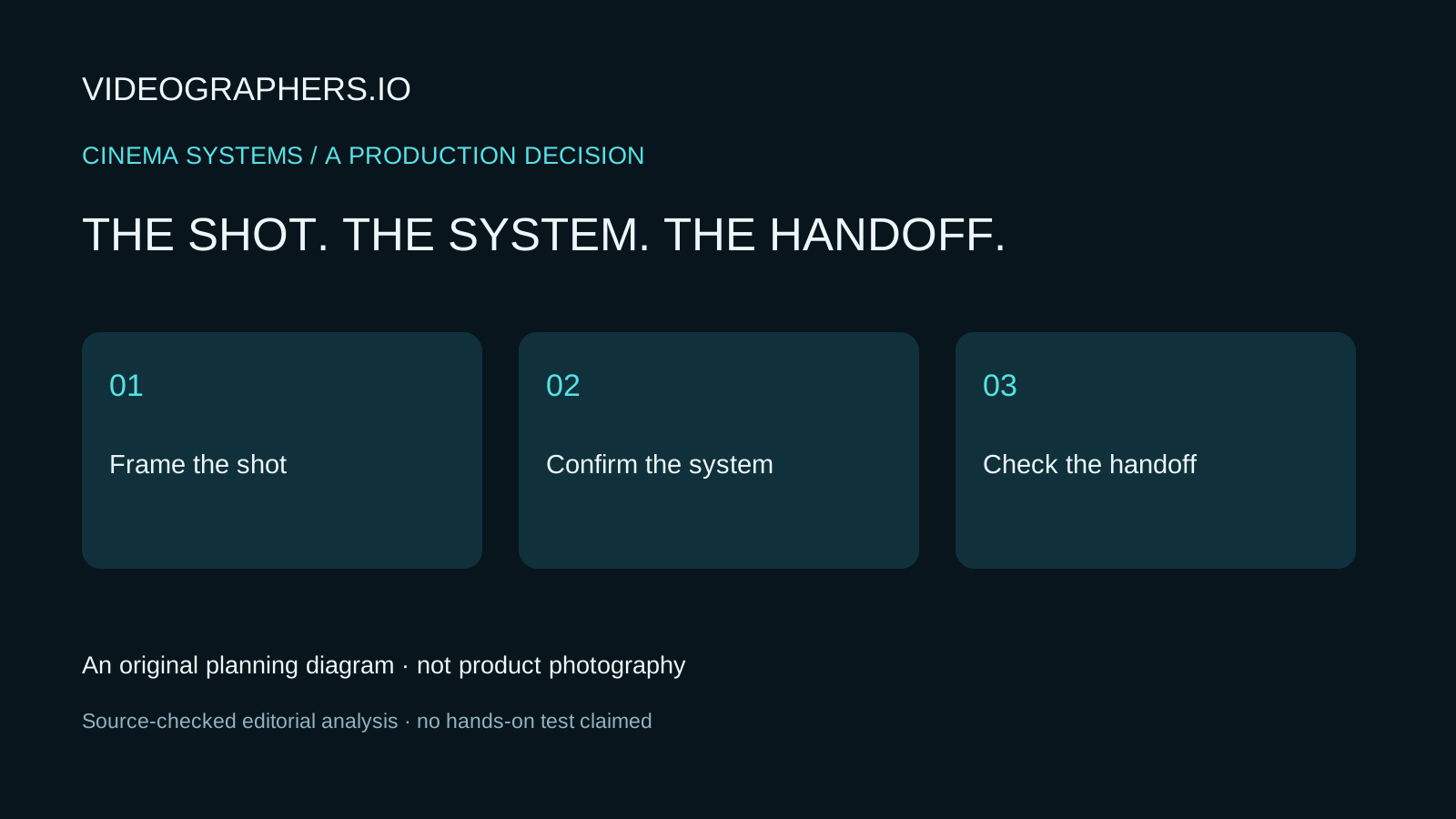
Original evergreen IAM guide. Official documentation checked 2026-11-13T01:06:04.857587+00:00. Source reference date: 2026-10-29. This is a new editorial guide, not a new platform announcement. The production scenario is fictional.
Define the decision for a product demonstration
In a fictional product demonstration, a presenter points to a control while the camera shows the result of using it. The sequence is understandable to someone watching closely, but the spoken explanation does not name the control or describe the visible change. The brief needs to identify which information the audience actually requires.
Sony's October 29, 2026 announcement describes RIALTO 65 as an extension system for VENICE 2 that expands the camera to the 65mm format. Sony said it was expected in the first half of 2027. These are attributed announcement claims, not a shipping confirmation, an independent test or a recommendation for every production. The remaining process suggestions and fictional example are original IAM editorial analysis.
Design the production brief before the camera package
A larger image format is a creative option, not a substitute for a production brief. Begin with the picture the viewer needs to understand: the object, the action, the person explaining it and the detail that must remain legible. Write those needs as shots before choosing a sensor format. A product film may need a clean overview, a close demonstration and a reliable view of an operator's hands. Those requirements can point toward different lenses, camera positions and lighting approaches. The useful question is how the proposed package serves each shot, rather than whether the newest announcement sounds impressive in a proposal.
Sony's announcement describes an extension system used with VENICE 2, rather than a self-contained replacement for every camera in a production inventory. That distinction belongs in the equipment brief. Ask the supplying rental house or authorised technical contact to identify the complete compatible package, including the camera body, extension components, recording arrangement, power, monitoring and the support required for the intended setup. Do not turn a photograph of one component into a complete kit list. Keep the supplier's current written confirmation with the job documents so the crew can distinguish an agreed configuration from an assumption copied out of an announcement.
Separate a desired visual quality from an untested explanation of how to obtain it. A director may want a spacious composition, a controlled background or a particular relationship between a product and a presenter. Describe that intention in ordinary language and test it with the actual lens, framing and working distance that the production can support. Avoid promising that a format label alone creates a particular image. The published announcement establishes what Sony says about the system; it does not establish how an untested camera and lens combination will behave in your room, with your lighting and the subject's real movements.
Make the framing plan specific enough for another person to challenge. Identify the intended delivery frame, where graphics may appear and which parts of the picture need to survive alternate versions. A central product demonstration might work in a wide master while a hand movement becomes difficult to read in a narrow crop. Mark the important action and discuss whether a second composition or a separate shot is a better answer than expecting one frame to serve every version. The production team's responsibility is to expose those trade-offs before recording, without inventing a supported camera mode or claiming that every requested crop is available.
Treat extension-mode planning as a physical workflow question as well as an image question. Sony describes separating the camera head from the body, but the location still has to accommodate the complete arrangement. Ask the responsible technicians to plan mounting, support, connection paths, access and movement using the actual supplier documentation. Keep operational and safety decisions with the people qualified to make them for the real rig and location. A production article cannot supply a substitute mounting specification. The editorial lesson is to include the whole system in the floor plan and crew discussion, rather than approving a small camera-head footprint while leaving the rest of the package unaccounted for.
Arrange a rehearsal around the shot's difficult moment. In a product demonstration, that could be the moment a presenter opens a component, turns an object or reaches across a label. Use an appropriately authorised stand-in or a permitted preproduction setup to check the composition, communication and practical access. Record what the rehearsal actually showed, including any limits. A remote discussion or an attractive reference frame is useful preparation, but neither is a camera test. If the proposed system is not available for a genuine test, label that uncertainty in the brief and keep a verified alternative configuration in the planning conversation.
Keep a production alternative tied to the same communication goal. Sony's October announcement gave an expected availability window, not a promise that a particular supplier will have a working package for a particular booking. Ask for current availability and confirmation when procurement becomes real. If the production cannot responsibly depend on the proposed system, decide which established arrangement can still deliver the agreed story and essential shots. That alternative should be evaluated on the actual deliverables, crew and location. It should not be framed as a failure to use a headline feature, nor should an unconfirmed future product be represented to a client as equipment already reserved for the job.
Make a location review answer practical questions rather than merely collect attractive reference photographs. Identify the available working area, the route into the location, the space needed for the subject and the places where crew communication may be interrupted. Discuss the actual proposed equipment with the responsible production and technical people before confirming those arrangements. A small camera head does not mean the entire production has become small, and a larger image format does not eliminate the need to coordinate sound, lighting and the people appearing in the film. Keep the review focused on what the real location can support and what remains to be checked. If an essential detail is not yet available, record the question and its owner instead of putting a confident but unsupported answer into the client brief.
Close the source, approval and delivery chain
Build a short claim ledger for the proposal. One column can hold statements supported by Sony's announcement, another can hold the supplier's confirmed package details, and a third can hold the production team's own creative recommendations. Keep those categories distinct in client-facing copy. A manufacturer can describe a sensor and an expected release window without establishing a rental price, the availability of a local technician or the result of a specific shoot. When a claim cannot be assigned to a current source or an actual test, turn it into a question for the responsible person. Do not let confident wording quietly convert a planning assumption into a verified capability.
Give the date a clear meaning. The source announcement is dated October 29, 2026, while this guide is an original editorial planning analysis published later. Sony said availability was expected in the first half of 2027. Those are separate facts, and neither should be rewritten as a present-day shipping confirmation. Before quoting an availability position in a real proposal, refresh the current first-party announcement and obtain confirmation from the actual supplier. Retain the source reference and the date you checked it. A successful website fetch proves that a page was accessible at that time; it does not by itself prove stock, delivery or fulfilment.
Discuss the recording and post-production handoff before the shoot. Ask the supplying technician and the editor to agree the actual recording configuration, media handling, transfer arrangement and software checks for the confirmed package. This guide deliberately does not infer codecs, frame rates, media capacities or data rates that have not been verified for the intended configuration. Instead, name the people who can confirm them and the test that will establish the handoff. A short authorised test file, played through the actual post-production path, can reveal a practical mismatch that a list of camera specifications would leave unresolved. Record what was tested and which configuration produced that file.
Make review responsibilities narrow and visible. The person approving a budget is not automatically the person who can approve a technical package, and a crew member confirming a connection is not necessarily approving the film's public release. Put those decisions beside the relevant names in the job record. Agree how the team will resolve a late equipment substitution or a change to the shot list. A concise written decision can prevent conflicting messages from becoming incompatible setups on the day. It also lets the client see which choices are confirmed, which remain conditional and which require another discussion before additional work is authorised.
Keep source photographs and production imagery honest. A photograph supplied with a product announcement can show the manufacturer's equipment, but it is not evidence that your crew used it, tested it or booked it. Use an asset only when its actual reuse terms and credit are established. An original diagram can explain a planning relationship without pretending to be product photography, a technical drawing or a record of a completed job. This guide uses a labelled conceptual illustration for that reason. It does not reproduce Sony's product photographs or imply a site visit, a hands-on review or a client production involving the announced system.
Review the final film against the agreed purpose rather than the prestige of the package. Can the intended viewer see the product's essential action, understand the explanation and read the information that matters? Do the delivered versions preserve the agreed compositions and approved wording? Keep a record of the exact cut, the supporting text and the person who consolidated corrections. If a visual choice made a critical action harder to follow, identify that limitation plainly. Equipment selection is one part of the production process; it cannot independently establish audience understanding, a commercial result or the adequacy of an instructional demonstration.
Retain a usable closeout record. It should connect the approved brief, the confirmed equipment arrangement, the source references, the test notes and the final delivery versions without exposing private client material in public marketing. Save a factual description of what the team actually did and mark any illustration or fictional example as such. If the planned system was replaced, document the change without rewriting the original source announcement or claiming an experience the crew did not have. That discipline makes a future production easier to prepare and lets a reviewer understand the limits of the evidence. It is also a stronger basis for discussing equipment than treating a launch headline as a completed workflow.
Give equipment changes a controlled route through the production record. If a supplier proposes another body, lens, extension component or recording arrangement, ask which parts of the agreed test and delivery plan must be checked again. Some changes may leave the communication goal intact while affecting the practical setup; others may alter what can be promised. Retain the actual supplier description and the production team's decision rather than quietly replacing a model name in an old document. The purpose is not to make the paperwork difficult. It is to let the people relying on the brief see whether the configuration they approved is still the one being prepared, and to preserve a sensible way of resolving a technical or creative question before a time-sensitive shoot.
Record the boundaries of an equipment comparison as carefully as its conclusions. If the team compares an established package with the proposed system, identify the actual scene, lenses, lighting, crew and delivery settings that were used. Note which variables changed and which could not be held constant. A practical rehearsal can support a decision about that particular job without becoming a universal ranking of cameras or formats. Keep the comparison's source files and reviewer notes where the authorised team can find them, and obtain permission before using any client material publicly. A useful production recommendation should be reproducible enough to question, limited enough to remain honest and specific enough to help someone prepare the next real decision.
Close this particular production handoff
Ask the product owner to confirm the names and the permitted claims. A demonstration filmed under one arrangement should not silently become a universal performance promise, independent comparison or hands-on review by this publication. If an important condition is unclear, preserve the question for the responsible reviewer.
Give the editor and publisher a list of the approved product terms, the cut identifier and the statements that still need confirmation. Tie any correction to the specific sequence. Do not hide a qualification in a production email while releasing an unqualified statement in the final audience-facing material.
The production record can show which version was checked and what explanation was approved. It cannot establish product reliability, a comparative advantage or the outcome a buyer will obtain. Keep the distinction visible when writing descriptions and accompanying text.
For an initial Videographers.io enquiry, describe the location, intended audience, timing and deliverables using the existing IAM email route. Do not send private client footage before agreeing an appropriate transfer arrangement. An enquiry does not confirm availability, acceptance or a booking.
Sources and editorial context
Manufacturer guidance is credited directly below. Examples and planning recommendations are original IAM editorial analysis, not hands-on testing or measured client results.
Sony Electronics — RIALTO 65 camera extension announcement — source date 2026-10-29
An enquiry does not confirm a booking, availability or provider acceptance. Include your location, project scope, intended dates and contact details. Avoid sending private client footage before agreeing a secure transfer route.