Put captions and transcripts in the production brief
An original accessible-media planning guide to deliverables, responsibilities and review before a film reaches the publishing handoff.
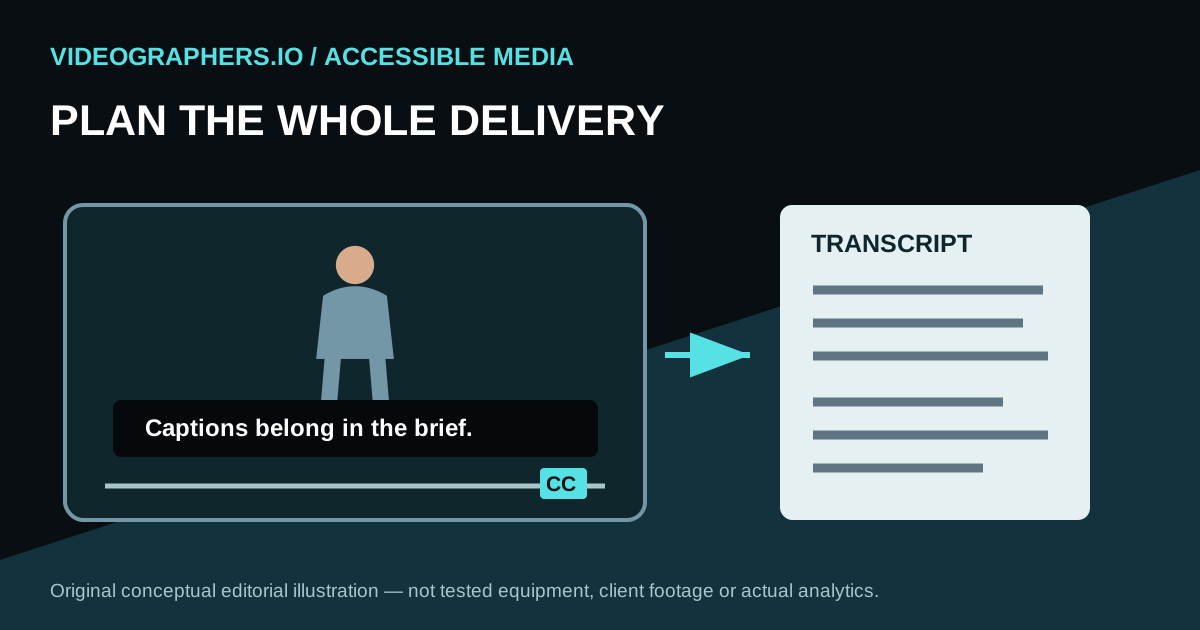
Original evergreen guide researched October29,2026. Source facts are credited below; examples and planning commentary are IAM analysis, not a new announcement.
Decide what will be delivered before the edit ends
A film delivery brief that names only the video file leaves important questions unanswered. Who prepares the captions? Who checks names and specialist terms? Where will the transcript appear? Which person tests the final publishing arrangement? These decisions are easier to discuss while the producer can still plan the work than after everyone assumes the project has finished.
W3C’s Web Accessibility Initiative recommends addressing media accessibility during project planning and identifying requirements in briefs and contracts. Its guidance distinguishes captions, transcripts, description and player support. This article is original IAM production-planning analysis grounded in that resource. It is not a legal opinion, a claim of WCAG conformance or an audit of a particular film or website.
Name each deliverable and the responsible person
For a fictional interview, list the film, caption file, transcript and any other agreed version separately. Ask the publishing team what formats and player they will use, then confirm those requirements with the production team. A transcript and a caption file serve different viewing arrangements even when they share text; one attachment should not silently be treated as completion of every requirement.
Write down who prepares each item, who reviews it and who can resolve an uncertainty about a name or spoken phrase. The client may need to supply correct terminology without becoming responsible for every production task. Clear ownership helps the producer understand what is included and what still needs agreement, without inventing a price or assuming a service was purchased.
Review the meaning as well as the words
A reviewer should understand what information the audience needs from the media. Spoken dialogue may not explain an important action visible on screen. A useful planning discussion asks whether additional description or a descriptive transcript is needed, using the W3C resource and the project’s actual requirements. Do not claim that adding a text file automatically makes every visual sequence accessible.
Keep a small set of review questions with the delivery checklist: are names correct, is the intended version identified, and are unresolved passages clearly marked for a decision? These are editorial coordination suggestions. Specialist accessibility assessment may be appropriate for the project, and the relevant policy or legal obligations must be established separately rather than inferred from this general guide.
Check the real publishing handoff
Agree who will check the film in the actual player and where viewers will find the associated text. Review the intended viewing arrangement rather than only opening a caption file in an editing application. Preserve the final approved versions and record any change after approval so that the publishing team does not unknowingly pair an old transcript with a revised film.
For a production business, this is a scope and customer-experience conversation. It makes the delivery package understandable and gives colleagues a practical way to identify unfinished work. It does not establish compliance, replace user testing or promise a commercial result. The useful goal is a documented set of deliverables, named reviewers and a checked route from the edit to the audience.
Sources and editorial context
Manufacturer guidance is credited directly below. Examples and planning recommendations are original IAM editorial analysis, not hands-on testing or measured client results.
W3C WAI — Planning audio and video media — source date not stated on the retrieved page
An enquiry does not confirm a booking, availability or provider acceptance. Include your location, project scope, intended dates and contact details. Avoid sending private client footage before agreeing a secure transfer route.