Use the retention curve to ask a better production question
An original video-marketing review method that treats audience-retention patterns as evidence to investigate rather than a guaranteed explanation of performance.
Original evergreen guide researched October29,2026. Source facts are credited below; examples and planning commentary are IAM analysis, not a new announcement.
Start with the moment, not a verdict
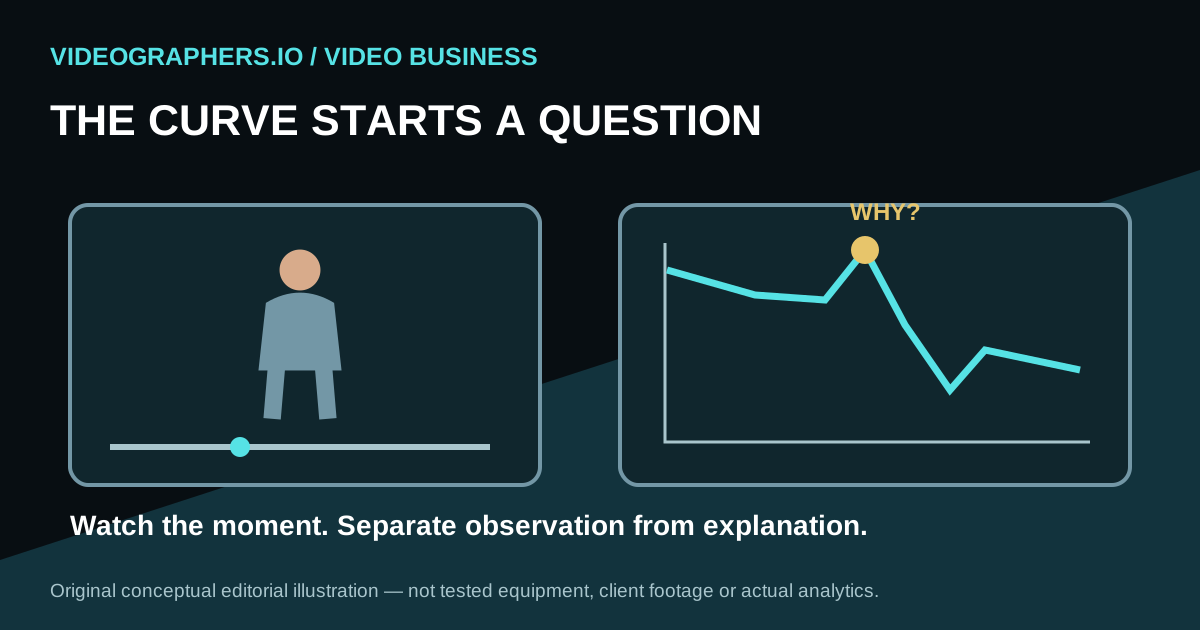
A retention graph can give a production team a place to look. It does not supply the complete reason a viewer stayed, skipped or left. Before telling a client that the opening is wrong or the middle is too long, watch the relevant part of the actual video and write down what question the pattern raises.
YouTube’s official Help describes spikes as moments that may involve rewatching or sharing, and notes that a spike can also reflect unclear content. It describes dips as skipped sections or viewers leaving. Its key-moment highlights have eligibility conditions and are not present on every video. This evergreen article offers IAM analysis of a review conversation, not a promise about rankings, sales or a universal target percentage.
Keep the observation separate from the explanation
In a fictional service demonstration, a rise appears around a close-up of an adjustment. The observation is that this section received more attention in the available report. Possible explanations include a useful detail, an unclear instruction or viewers returning to check a step. The curve alone does not establish which explanation is correct or whether the business gained an enquiry.
Write the observation, time range and proposed explanation in separate fields. Include the viewing period and the context available to the channel owner. Avoid comparing unlike videos as though a single percentage settles their quality. A short customer introduction and a detailed training film may serve different intentions even when both are made by the same production company.
Connect the question to something the team can change
Choose a specific production hypothesis for the next suitable film. Perhaps the demonstration needs a clearer view of the tool, or the title should describe the question the opening actually answers. Explain why that change addresses the uncertainty. Do not make several unrelated changes and later claim that one of them caused a difference without evidence.
YouTube’s guidance encourages reviewing the content around spikes and dips. The original business practice proposed here is a brief review log: observed moment, possible reason, planned change and later check. The log should preserve uncertainty. It is a useful way to remember a decision, not a substitute for an appropriate measurement design or a guarantee that the next video will improve.
Report what the evidence can support
Ask the client what they want the video to help a viewer understand or do. Discuss that objective alongside the available viewing report and any separately verified business evidence. Do not turn watch time into booked revenue, or an engaged viewer into an identified customer. The channel owner should control access to private analytics; a public case study needs permission and accurate context.
For a production business, this approach creates a more useful follow-up than sending a graph with an unexplained judgement. It gives the client a clear observation and a practical question for the next brief. Results may remain uncertain, but the team can still make a documented creative decision without pretending that a chart provides a complete account of audience behaviour.
Sources and editorial context
Manufacturer guidance is credited directly below. Examples and planning recommendations are original IAM editorial analysis, not hands-on testing or measured client results.
YouTube Help — Measure key moments for audience retention — source date not stated on the retrieved page
An enquiry does not confirm a booking, availability or provider acceptance. Include your location, project scope, intended dates and contact details. Avoid sending private client footage before agreeing a secure transfer route.