Review caption meaning before approving delivery: an event recap
A practical review for an event recap focused on changing speakers, background sound and moments that cannot be repeated.
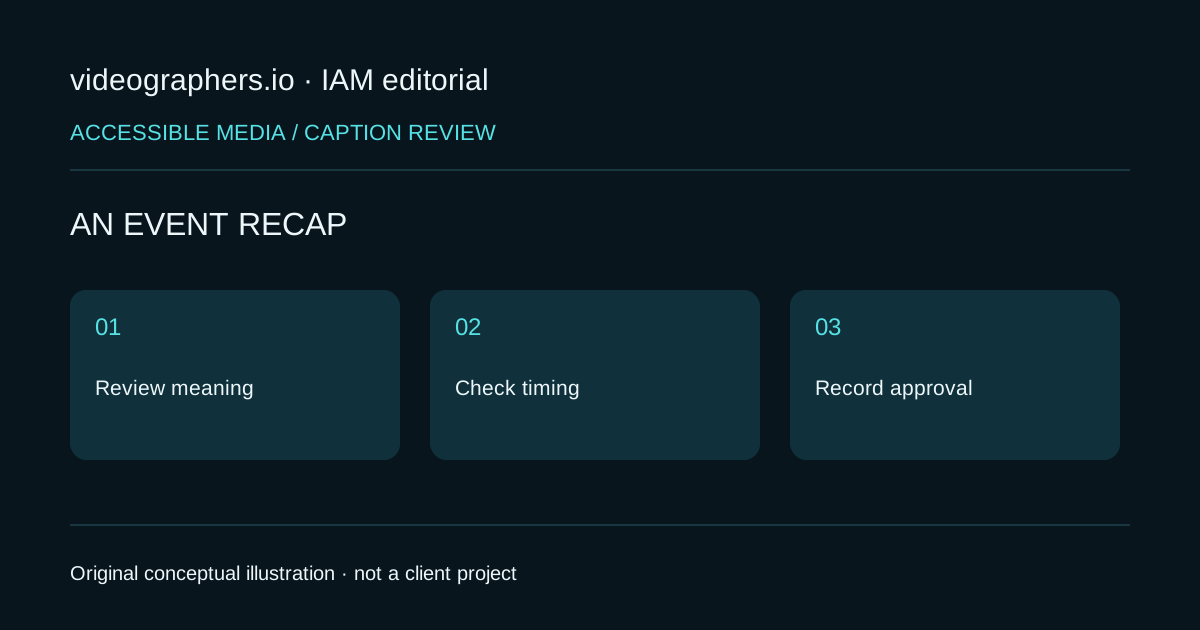
Original evergreen IAM guide. Official documentation checked 2026-11-10T21:20:52.137264+00:00. Source reference date: 2024-09-17. This is a new editorial guide, not a new platform announcement. The production scenario is fictional.
Define the decision for an event recap
In a fictional community event recap, a short welcome leads into applause and a presentation. The edit includes a speaker who was added after the printed programme. A production note copied from the original schedule would identify the wrong person even if the film itself appears finished.
W3C WAI describes captions as text for speech and relevant non-speech audio. It distinguishes captions from translation subtitles and explains that sound information can matter to understanding the media. The remaining process suggestions and fictional example are original IAM editorial analysis.
Check the words that change the story
Start the review with names, numbers, specialist terms and changes of speaker. A spelling error in a decorative title is different from a mistaken instruction or an incorrect name attributed to an interviewee. Keep a small terminology sheet with the approved spellings and identify who can answer a question about the spoken material.
Ask whether a viewer can identify the relevant speaker and understand an important sound without hearing the soundtrack. Do not insert every incidental noise merely because it occurred on set. Discuss which sounds carry meaning in this film and keep the reviewer’s interpretation open to correction by someone who knows the material.
Approve text in time, not only on a page
Read the captions while playing the approved cut. A text document can look accurate while the displayed line belongs to an earlier shot or arrives after an essential response. Note the cut version, caption file and playback arrangement used for the check so that another person can reproduce the review.
Collect corrections in one place and assign a person to close them. A client email saying the video looks good may not establish that the captions were checked. Name the actual approval being requested, including unresolved terminology, and retain the final agreed file alongside the delivery record.
Close this particular production handoff
Ask the organiser which names and moments can be published and who can resolve a late programme change. Separate a record of what was filmed from permission to release it. Public attendance alone should not be treated as the production team’s complete publication authority.
Keep the current running order, actual recorded moments and approved name spellings with the cut. Identify any segment whose meaning depends on a sound, a speaker change or a visual detail. Make one organiser responsible for consolidating corrections so that the editor does not receive incompatible versions of the event.
A good event handoff records what was delivered and which content the organiser approved. It should not promise complete coverage of every moment, imply a crew could be in two places at once or turn an enthusiastic audience reaction into a measured commercial outcome.
For an initial Videographers.io enquiry, describe the location, intended audience, timing and deliverables using the existing IAM email route. Do not send private client footage before agreeing an appropriate transfer arrangement. An enquiry does not confirm availability, acceptance or a booking.
Sources and editorial context
Manufacturer guidance is credited directly below. Examples and planning recommendations are original IAM editorial analysis, not hands-on testing or measured client results.
W3C WAI — Captions/Subtitles — source date 2024-09-17
An enquiry does not confirm a booking, availability or provider acceptance. Include your location, project scope, intended dates and contact details. Avoid sending private client footage before agreeing a secure transfer route.